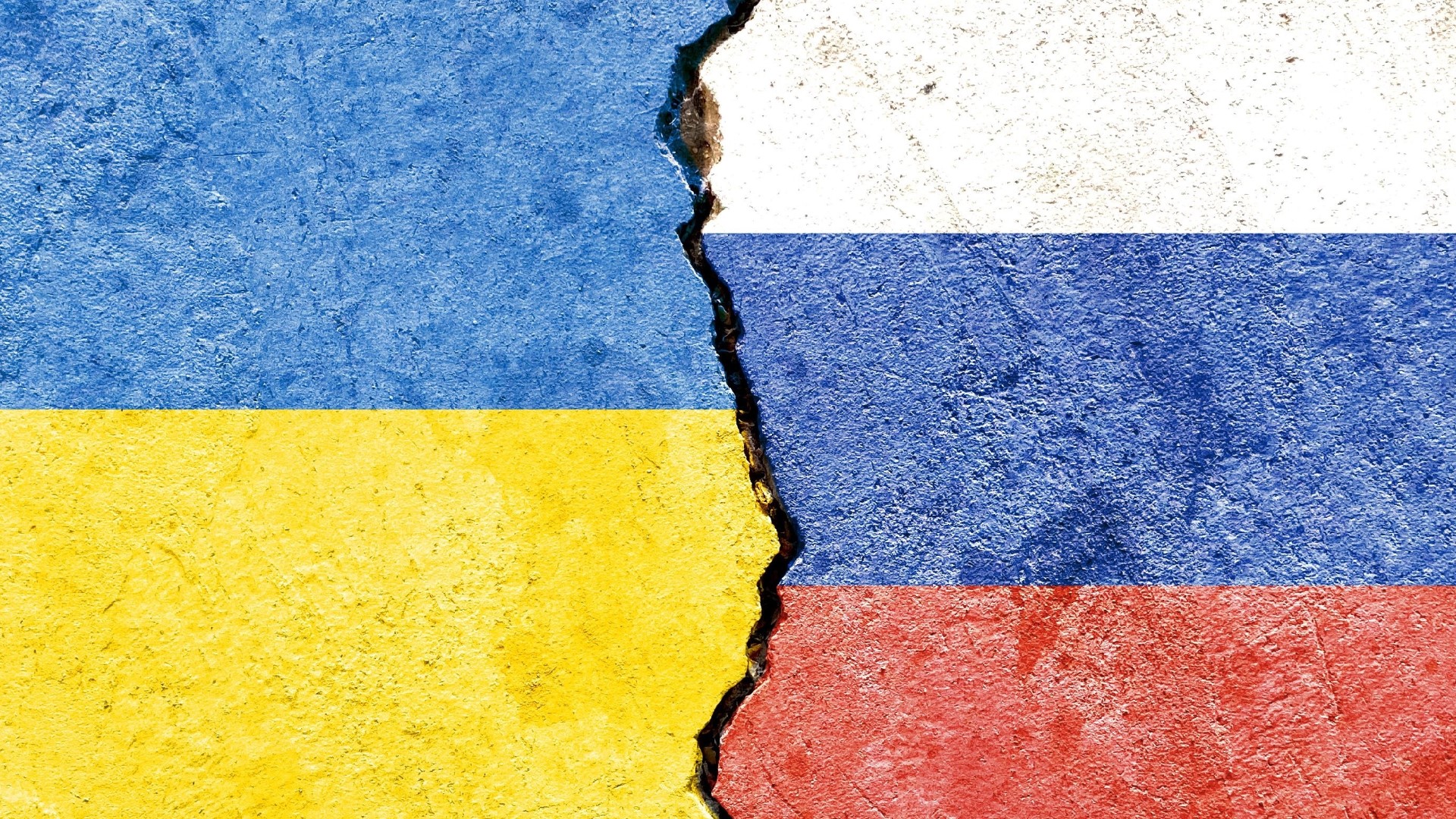
Ukraine Online: Twitter’s real-world impact on the conflict’s early days.
How did the way users engaged with Twitter impact the lives of those who lived through the beginning of the conflict?
We will delve into the context and background of the conflict, before diving into the minute details of day by day tweets form those in Ukraine and also the global community.
In an online world…
“The war…is also taking place in a world where social media is ubiquitous, video and images can be quickly uploaded and shared worldwide, and both sides are using social media to rally support and spread information and disinformation.”
Sara Brown, MIT
Narrative
Humans have engaged in conflict long before the modern era. Throughout time, technology changed the way groups fought, from the differentiation of battle tactics to biological warfare to the rise of guns, it has been a continuous evolution. That evolution is still present today, albeit from a different perspective: that of the civilian. The advent and popularity of social media have transcended borders, leading to unprecedented communication between both combatants and noncombatants which we will analyze on this site.
One of the central topics we intend to discuss is the increase in information shared online about human conflicts. Who is posting, what are they posting, how is it being posted, and what third parties may have an interest in interfering?
In order to understand this topic, we’ll delve into how information shared online may be biased to one side, and we’ll look at who it influences. In order to investigate this, our case study looks at tweets that have a specific human impact, whether it be direct or cascading. A few examples taken from our dataset follow in the “This begs the question’ section down the page.
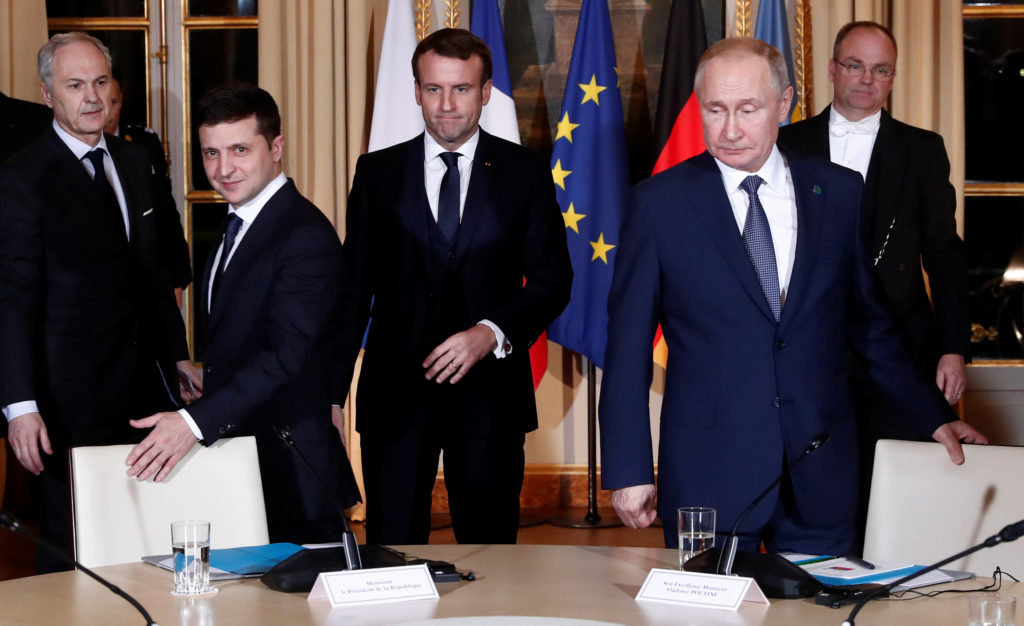
The current conflict between Russia and Ukraine has global implications, and has been brewing long before the advent of Twitter, or any social media site for that matter. If we were to start back 100 years ago, we’d see the path for conflict already being set in place. After the Russian Revolution in 1917, Ukraine went in and out of independence. After five years, Ukraine was absorbed into the Soviet Union, setting the stage for the next 70 years. Differences in ideologies, and impractical government policies led to a strained relationship between the Russian and Ukrainian populaces. After the dissolution of the Soviet Union in 1991, Ukraine was independent for the first time in many decades. This history of entanglement between Russia and Ukraine has led those in power, including Russian president Vladmir Putin, to wish to return to the “glory days” of the once stronger Soviet Union, which would include control over Ukraine. This was seen in a recent interview with Tucker Carlson, where Putin explained his perceptive and narrative, diving into the history and masquerading his intentions behind simple historical circumstances.
Our sources include a dataset that captured tweets relevant to the topic within the first four days of the conflict, and also other news sources and scholarly journals that investigate the impact that the digital landscape has when viewed through the context of engagement around a conflict. Some examples include an article entitled “In Russia-Ukraine war, social media stokes ingenuity, disinformation” by Sara Brown at MIT, and also “Guns, tanks and Twitter: how Russia and Ukraine are using social media as the war drags on” by Collette Snowden at The Conversation. These contextual articles, in tandem with scholarly journals, help derive a sense of place and space in terms of a political and geographic context when combing through our data, which ultimately allows for a humanistic story to be told.
The use of words in our context remains of crucial importance. What people are saying, how they are saying it, and who it’s being said to all change the impact a message can have. From February 1 to March 23, the word Russia, fight(ing), and war were used 47, 32, and 30 million times respectively on Twitter. Each of these messages were meant to be seen by another person, and in some way likely influenced how they felt about the topic. Without social media, or any media for that matter, it would take multitudes longer for any information to be delivered to the rest of the world. The advent of social media has allowed information to spread in near real-time, influencing the outcomes of any conflict.
Our main dataset, is entitled “Ukraine War: Twitter Sentiment Analysis” and is found on Kaggle. This data covers the reactions of the worldwide Twitter community to the initial days of the conflict, February 24 – February 28. Through this, we hope to gain an insight into what was being said, who was saying it, who was seeing it, and why it was impactful. Given we have access to the actual word-content of the tweets, and metadata surrounding them such as retweets, favorites, and times, we will be able to connect specific tweets to outside sources and discover the human impact that was being undertaken by the events being spoken about through the lens of Twitter. Further, since there is an engagement score associated with each tweet, it’s possible to uncover why certain tweets were better engaged with than others, and how it related to the events and the people experiencing them.
A fair starting point for diving into the data is a timeline of sentiment.
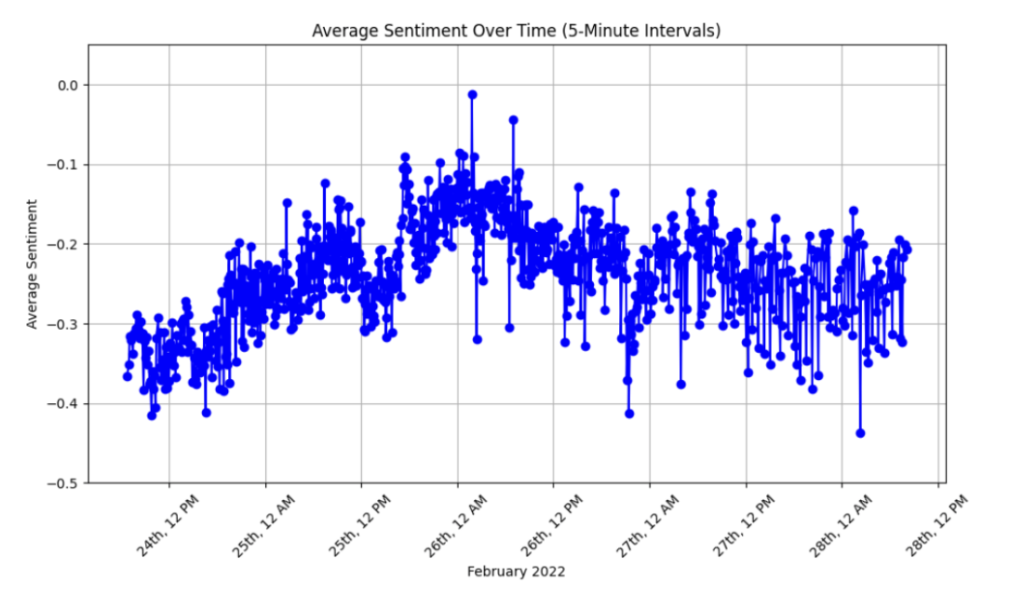
As we see from the graph above, sentiment scores started out negative and remained there, though they trended upwards towards the positive as the first few days of the conflict passed.
This begs the questions: What exactly was being discussed, by who, and what impact did it have?
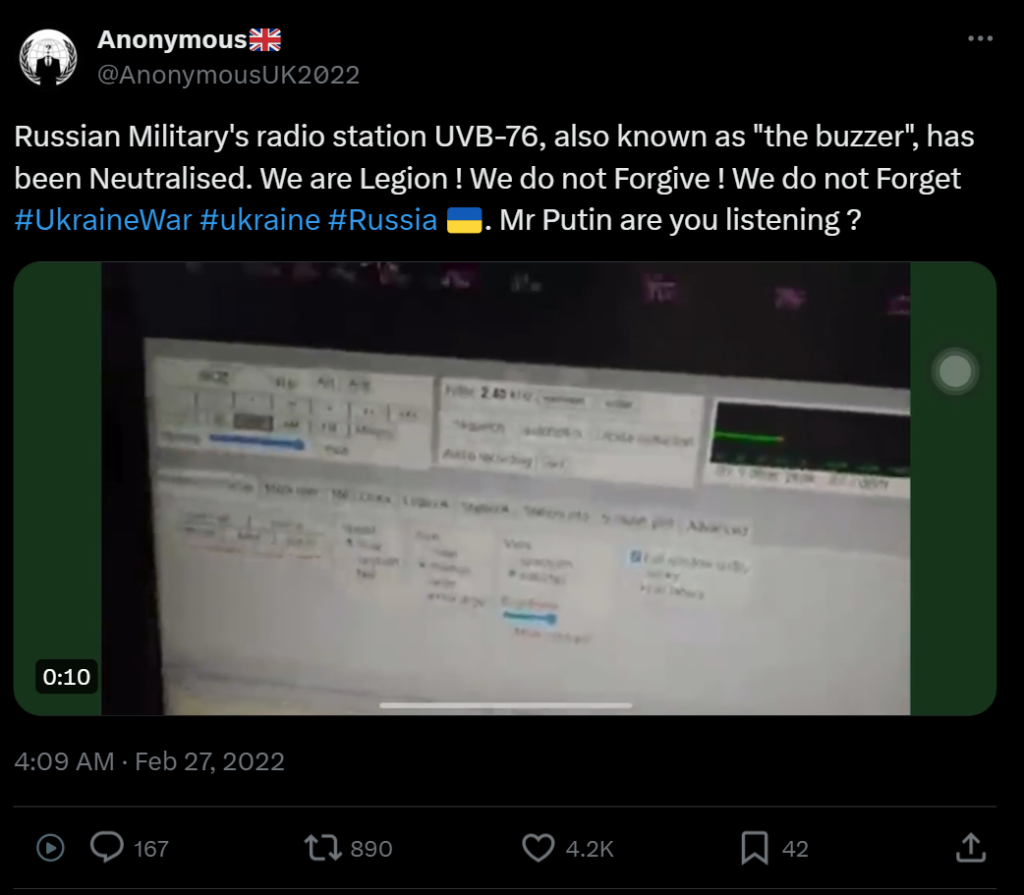
The above is relevant because it gives people living through the war hope, hope which lies outside their government or even their brethren. When they read tweets like this, they may feel a sense of optimism knowing that there are groups around the world on their side, fighting. The neutralization of a radio channel may have saved Ukrainian lives, as it would significantly delay military advances and allow more time for civilians to escape.
We can see an example of how groups such an Anonymous aided Ukraine in the literature. In their article entitled “Tweets in Time of Conflict,” which looks at a similar twitter dataset, the authors noted that ‘…other highly prevalent hashtags include #anonymous, which referred to the announcement by the decentralized online hacking group Anonymous that they would be targeting Russian government websites and infrastructure while aiding Ukrainians” (Chen et. al. 1009). The impact that the use of social media has on those on the ground goes both ways, though. From online to the real world, and from the real world to online. This is seen in tweets such as one posted on February 24 by the user JoeSmols which reads
“My eyes hurt, too much crying in the last 24 hours, I’m 50ish, I NEVER EVER THOUGHT my 1st born would be going to fight a war, @KremlinRussia_E is killing innocents and doesn’t care. I’m scared and want my son home alive and healthy. #StandWithUkriane #Ukraine.”
JoeSmols, Twitter
This heartbreaking tweet encapsulates what so many on the ground have gone through. The pain that this parent feels knowing their child must fight to defend their country, and potentially lose their life, is unimaginable. We see a direct correlation from the events experienced in real life, to that activity reflected online. Twitter has become an extension of the collective human conscious. In the aforementioned article, the researchers were able to show that the “…data also shows that spikes of tweets in a particular language generally occur alongside major real-world events” (Chen et. al. 1008). This draws a direct connection from the digital, to the humanity. We see that when things happen in real life, to real people, they are relayed digitally to other real people, and that message in turn has an impact on people.
This concept of the connection between the digital and the physical is further outlined in an article entitled “In Russia-Ukraine War, Social Media Stokes Ingenuity, disinformation” by Sarah Brown for MIT. In the previous “Tweets In Times of Conflict” article, the authors of the article discuss how their data “…shows that spikes of tweets in a particular language generally occur alongside major real-world events.” (Chen 3). We see from this a direct connection between the digital and the physical. Sarah Brown’s article can exemplify this phenomenon, as she lays out by saying “Zelenskyy is using traditional, social, and encrypted media to spread information…and Mykhailo Fedorov, Ukraine’s minister of digital transformation, has “declared World Cyberwar I,” …For example, he used Twitter to contact Chinese drone company DJI and convince the company to create a geofence preventing its technology from working inside Ukraine” (Brown). Here we see a concrete example of how social media was used to impact the war. Similar to the Anonymous example, this event differs because it was a case of a government official contacting another entity through the twitter service, which enabled them to help their cause. Not having Russian drones flying overhead likely saved lives, while at the same time boosted the morale of the Ukrainian people and military.
Literature Review
In preparing for our analysis, our team searched through troves of literature related to the advent of social media, and its use in conflict. There has been deep documentation performed on the subject, since the medium has become of vital importance to not only everyday civic use, but also in a strategic military context as well.
Our main sources are derived from articles that discuss the technical side of why social media has been utilized by governments and other entities in a context of conflict. It’s generally thought that this is a continuation of what we saw in the past. There are those amongst us in the world who wish to control a narrative, as they realize that is what makes or breaks a nation when it comes to times of war.
The side that has been less explored is who is being impacted, and why. That is where we hope to employ our skills to derive the fundamental humanistic insights showing us how data sent online translates to the lives of people on the ground, both inside the conflict and out. With that being said, it’s important to provide context as to which words were being used, and in what way.
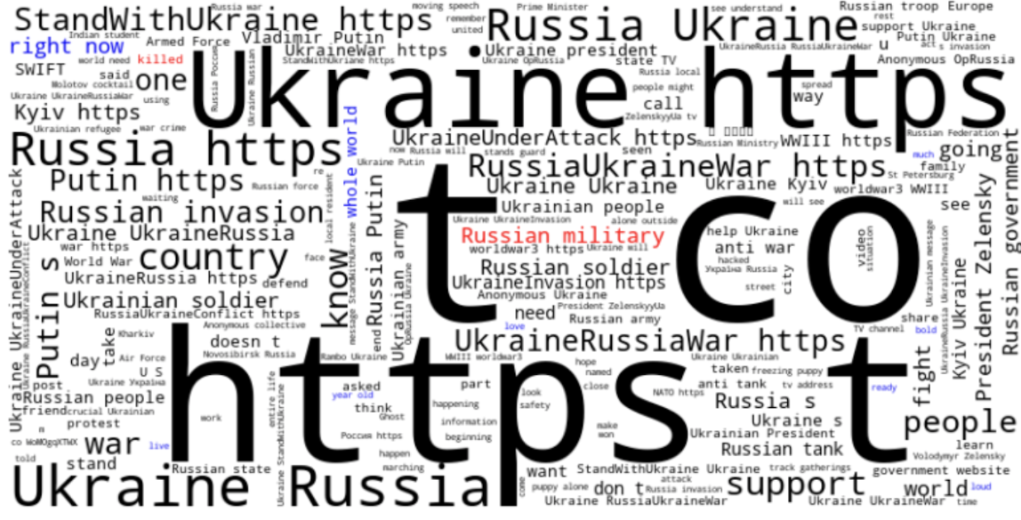
The above word cloud shows us the most common phrases used in all tweets over our times period. In red, we see words considered to have a negative context, and in blue, we see those used in a positive context. As we explored the literature, we were able to make connections between these words and the findings of scholars and researchers.
According to the research article “An Analysis of Twitter Discourse on the War Between Russia and Ukraine” composed by multiple researchers in June 2023, the researchers closely examine the content shared on social media and user participation. Their findings explained the spike in sentiment towards 0 on February 26. Over large datasets of tweets, Haris Bin Zia and their colleagues observed that user interactions are heavily influenced by political campaigns and the occurrence of major events such as the invasion of Ukraine. The studies also pointed out that users tend to engage with pro-Ukrainian content more than pro-Russian, which might be shaped by political campaigns that aim to change citizen’s opinions. To dive deeper into the significant influence of political propaganda that can manipulate individuals’ ideology during war, Emily Chen and Emilio Ferrara, two scholars presented a study that illustrates this matter. In the scholarly article “Tweets in Time of Conflict: A Public Dataset Tracking the Twitter Discourse on the War Between Ukraine and Russia”, the authors dive deep into a comprehensive Twitter dataset and conclude that the political social media content and propaganda spread by Russian can heavily influence public opinion regardless the reliability of the sources. Such efforts during the war resulted in measurable spikes in engagement on Twitter. It’s well known that Russia used the spread of unreliable information as information warfare, which disseminated support for Ukraine and caused the overall public opinion to swing over time.
Similarly, Mhah and Wasum also focus on the information warfare that has developed due to the conflict between Russia and Ukraine in “Russian-Ukraine 2022 War: A review of the economic impact of Russian-Ukraine crisis on the USA, UK, Canada, and Europe”. The researchers revealed that much of the content that was shared by various media sites, but mostly Twitter, was edited and dishonest. A majority of the content that was manipulated was about Russian soldiers and their attacks against Ukraine. This information gathered in this study further explained how key political events can affect the perception of Russia’s involvement in the war and the effects it had on Ukraine. This perception in turn impacts how those experiencing an event act, and thus can change the outcome of the event.
To further elucidate our literature context, we dove into articles based on social media, war, Russia, Ukraine, and the people from these respective areas. Researching how human conflicts are discussed on online platforms, it was important to see the level of biases and how the people of Ukraine and Russia were marginalized. It has become evident that “online media environments have changed the way young people access news,” which greatly shaped our findings on our research with how people from Ukraine and Russia were affected by the war (Schwaiger). With the use of four scholarly articles we were able to find the effects of social media on shaping sentiments, particularly on Twitter. In a recent study it was said that “the conceptual framework presented proposes that individual user characteristics of anonymity and authority influence platform effects including hashtag position and positive and negative bandwagon effects which impact expressed sentiments” (Sampat). The interplay of information overload, emotional contagion, and sentiments is crucial in learning how these social media apps optimize their online reputation. In another study it was researched that “this study identifies multiple emergent themes in the existing corpus, thereby furthering our understanding of advances in social media research” (Kapoor). With these findings it was important for us to dive deep into how people were affected by this war in order to find a more humanistic approach. A study showed that “levels of depression and anxiety were relatively low, while stress and resilience were relatively high among Ukrainians affected by the war” (Kurapov). These peoples, regardless of their age, gender, or living conditions were all strongly impacted by the war and it is evident in their health conditions and interactions online. Collectively these articles highlight the multifaceted nature of individuals’ engagement with news and information on social media platforms, showing the effects of social media on sentiment expression. Some questions around power dynamics and how people who control twitter versus people who were affected by that still remain. It became evident that there is a complex interplay between individuals’ personality traits and the influences of social media on shaping sentiments, all of which contribute to nuanced conception of how individuals engage with news in the digital age.
Significance
The conflict in Ukraine, while it may seem far away, is something that impacts us all. Whether we like it or not, geopolitical situations have far reaching effects, that may ultimately lead to our own front door. Technologies like social media help bridge the gap between the perceived distance from conflict to here. This can be both beneficial and harmful, as it may feed into our anxieties about the state of the world. The ultimate goal of our research is to help uncover how both Twitter users, and people living through the conflict, both influenced and were influenced by the interplay between technology and conflict. These ideas are discussed in the article entitled “Experimental evidence of massive-scale emotional contagion through social networks” by Kramer et. al. In this article, they explain that “emotional states can be transferred to others via emotional contagion, leading people to experience the same emotions without their awareness. ” (Kramer et. al.). The relevance of this article lies in the fact that we are increasingly moving toward a more online world as has been outlined on this page. Whether it be in sales, politics, celebrities, events, or in this case large-scale conflict, the advent and rise of social media has forever changed the way users interact with and gain access to the content that used to be much more difficult to obtain. This is all to say, that there is a clear connection between the digital and the physical. It’s seen in how Anonymous hackers are able to change the lives of those on the ground through the destruction of a Russian radio channel, in the way parents react to the news their kids may be taken to the frontline, and also in the way that the leaders of nations interact with their people. Social media is here to stay, and it has become forever engrained with the physical.